


 設定
設定
 快速送達
快速送達
 免運費
免運費
 國貿條規
國貿條規
 付款類型
付款類型


 商城產品
商城產品

Development Kits Accelerate Energy-Harvesting Wireless Sensor Designs
資料提供者:Electronic Products
2013-09-18
Wireless sensor systems have emerged as a major focus in the drive to ubiquitous embedded and connected devices in the Internet of Things. In the face of continued market pressure for extended operation of these devices, engineers can turn to energy-harvesting methods able to power these embedded systems from ambient energy. To gain experience and accelerate development of ambient-powered wireless sensor designs, engineers can take advantage of available development kits from manufacturers including EnOcean, Microchip Technology, Silicon Labs, and Texas Instruments.
These types of systems have traditionally required robust power sources to meet requirements for transmission range and data throughput rates. With advances in low-power ICs and improved design methods, engineers can create wireless designs able to meet substantially lower power requisites. Furthermore, many wireless sensor applications allow engineers to reduce wireless power requirements, due in part to the limited range and data rates needed for the application. As a result, energy-harvesting methods have emerged as an effective solution for powering wireless sensor designs.
A typical energy-harvesting wireless sensor system combines an MCU, sensor-signal acquisition circuitry, and a radio with a power supply subsystem capable of extracting and managing power from ambient sources (Figure 1). At the heart of the power subsystem, separate circuits harvest power from energy transducers, manage energy storage, and deliver a suitable supply to the application.
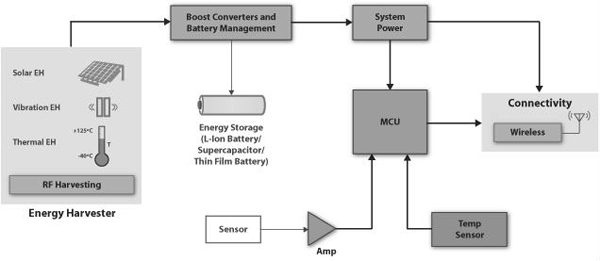
Creating an effective wireless sensor design using energy-harvesting methods can pose a significant challenge to engineers looking to meet tight delivery schedules in a fast-moving market for embedded sensor products. Thanks to the ready availability of suitable development kits, engineers can quickly gain experience with these types of designs, and even use these kits as a design baseline to rapidly build specialized systems.
EnOcean's EDK300 development kit offers engineers a full complement of hardware and software for designing a wireless sensor node powered by ambient energy. Available for 868 MHz (EDK300) operation, the EnOcean kit includes an evaluation board for the STM300 energy-harvesting module as well as EnOcean Programmer, test rocker, and USB cable.
The STM300 (Figure 2) is a module containing the ultra-low-power EnOcean Dolphin EO3000I ASIC, a 16 MHz oscillator, and balun, providing the foundation for different types of energy-harvesting wireless sensor designs. Consuming only 80 nA in sleep mode with active wake-up timer, the Dolphin ASIC combines an 8-bit 8051 MCU, RF transceiver, 12-bit ADC, 8-bit DAC, Flash memory, and RAM. The on-chip RF transceiver uses ASK modulation at 868.3 MHz for Europe or 315 MHz for the U.S., Canada, and Asia.
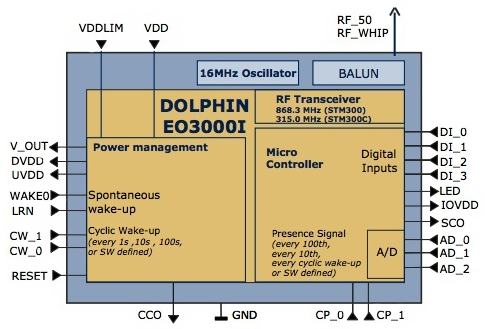
EnOcean provides an extensive software development environment comprising DolphinAPI for programmatic access to features in the EO3000I ASIC; DolphinView for viewing detailed radio information including signal strength, and DolphinStudio for configuring the Dolphin ASIC including its RF parameters and I/O pins, as well as programming the chip.
Silicon Labs offers a development kit built around its SI100x SoC that integrates an 8051 MCU, analog blocks, digital I/O, and SiLab's EXRadioPRO transceiver (Figure 3). The SI101x series offers a lower price point at a reduced on-chip memory configuration compared to the SI100x series.
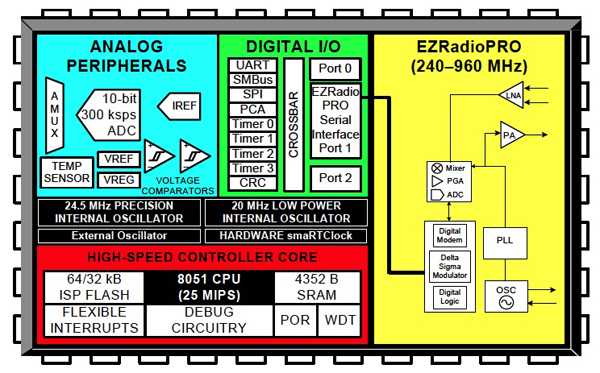
The SI1000DK and SI1010DK development kits are designed to support the Si100x and Si101x SoCs. The kits come with a high-band (868/915 MHz) daughter card radio, but Silicon Labs also offers daughter cards at low-band and lower transmit power. A CD-ROM in the kit includes the Silicon Labs IDE, Keil 8051 development tools, Keil uVision drivers, CP210x USB to UART virtual COM port drivers, and configuration wizard.
Texas Instruments offers an energy-harvesting development kit built around its MSP430 MCU. The EZ430-RF2500-SEH kit comes with a high-efficiency 2.25 in.-square solar panel designed for optimum energy production under low-intensity indoor florescent lights. It provides sufficient power to operate a batteryless wireless sensor application, as well as inputs for external energy harvesters such as thermal, piezoelectric, or another solar panel. The TI board also includes a pair of thin-film rechargeable EnerChips capable of delivering sufficient power for over 400 radio transmissions.
Microchip Technology offers a comprehensive wireless sensor development kit built around its PIC MCUs. The Microchip TPWR001 kit provides a complete wireless sensor design built to draw system power from ambient RF energy. Along with RF transmitter and receivers for testing its wireless power functionality, the TPWR001 kit includes a 915 MHz 802.15.4 radio module, Microchip XLP 16-bit development board, PICkit3 programmer, and USB cable. The XLP 16-bit development board comes preloaded with access point software.
Conclusion
Energy harvesting offers distinct advantages for powering wireless sensor designs. In the past, engineers were forced to deal not only with the challenges of creating an ultra-low-power wireless sensor solution, but also with the multiple factors that complicate efficient energy harvesting. Available development kits combine wireless sensor designs with a power subsystem aimed at harvesting energy from microwatt-level energy sources. Using these development kits, engineers can quickly gain experience in energy-harvesting designs and accelerate design of specialized ambient-powered wireless sensor applications.
聲明:各作者及/或論壇參與者於本網站所發表之意見、理念和觀點,概不反映 DigiKey 的意見、理念和觀點,亦非 DigiKey 的正式原則。







 台灣
台灣