設定
設定
 快速送達
快速送達
 免運費
免運費
 國貿條規
國貿條規
 付款類型
付款類型


 商城產品
商城產品

The Significance of the Intrinsic Body Diodes Inside MOSFETs
資料提供者:DigiKey
2016-09-22
Figure 1 shows a cross-section of an N-channel enhancement-mode MOSFET with the intrinsic body diodes indicated symbolically. These MOSFETs have diodes in them pointing from the body to the drain and source. The body to source diode is usually irrelevant, because it is shorted out by an internal body to source connection.
These diodes are appropriately named body diodes, and with the exception of JFETs, they are intrinsic to any FET type. There are P-N junctions in the FET structure between the substrate and the doped regions.
Current typically flows from the drain to the source in N-channel FET applications because of the body diode polarity. Even if a channel has not been induced, current can still flow from the source to the drain via the shorted source to body connection and the body to drain diode. Because of this, a typical N-channel FET cannot block current flow from its source to its drain.
In some applications, such as certain DC-to-DC converters, the body diode is actually relied upon for normal circuit operation. In contrast, it doubles the number of FETs necessary in other applications, such as certain power source selectors, where current must be blocked in both directions.
The two back-to-back P-N junctions also result in an intrinsic BJT (Bipolar Junction Transistor) within the FET; however, with a shorted body to source connection it effectively ceases to exist.
More considerations regarding MOSFET construction and operation are available here.
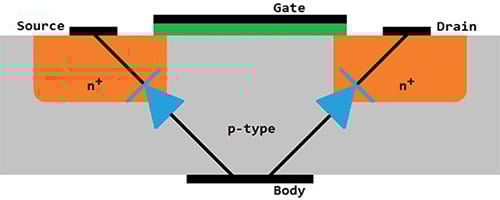
Figure 1: Cross-section of an N-channel enhancement-mode MOSFET with the intrinsic body diodes indicated symbolically.

聲明:各作者及/或論壇參與者於本網站所發表之意見、理念和觀點,概不反映 DigiKey 的意見、理念和觀點,亦非 DigiKey 的正式原則。